Peaches Corner: The Ocean Boulevard Corner That Stayed
A detailed, source-linked look at Peaches Corner: the 1937 opening, the family story behind the name, and why a small counter restaurant still carries so much Ocean Boulevard history.
Category: guide | Published: 2026-08-25
Some places are famous because they are big. Peaches Corner is special for almost the opposite reason. It is a compact restaurant at 900 North Ocean Boulevard, at the intersection with Ninth Avenue North, that has kept showing up in the same part of Myrtle Beach through generations of change. The story is not that it is frozen in time. It is that a family-run business has kept its place on a street that is constantly being rebuilt, reimagined, and reintroduced to new visitors.
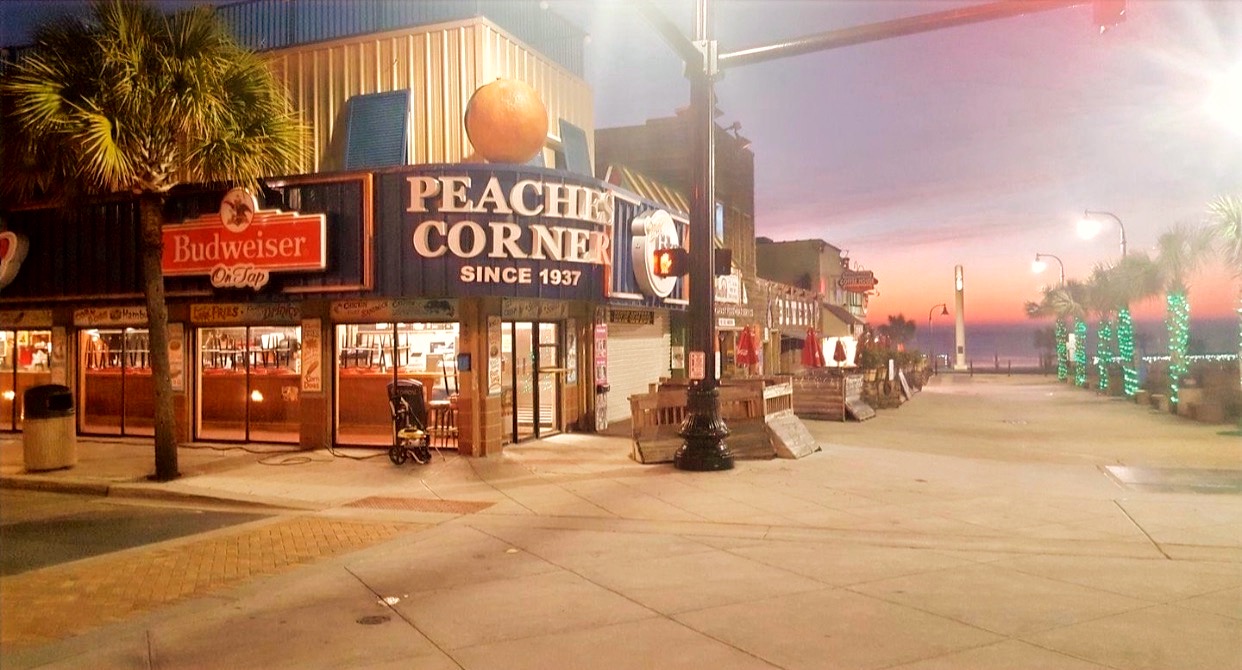
Photo: Official Peaches Corner website; current Ocean Boulevard storefront image.
The restaurant’s own history dates the Myrtle Beach location to 1937. Its official account names Peach Justice—known as “Momma Peach”—as the original owner and says she and her family operated the business until 1943. That same account says Johnny and Eunice Burroughs bought the property in 1943 and retained the name. An independent South Carolina Department of Parks, Recreation and Tourism feature reaches the same basic outline: Peaches began in 1937, later passed to Eunice Burroughs Singleton’s family, and continued as a family-run Ocean Boulevard restaurant.Peaches Corner official history Discover South Carolina
That is the foundation. Everything else—the footlongs, the rotating peach, the counter stools, the beach crowds, the memories people attach to the block—makes more sense once you understand that the business has been part of the street for nearly nine decades.
A name that outlasted the first owners
The name is not a generic beach-town invention. According to Peaches Corner’s official history, it came from Peach Justice, the woman remembered as Momma Peach. The site says there were once three Peaches locations: one in Myrtle Beach, one in Folly Beach, and one in Carolina Beach, North Carolina. The Myrtle Beach restaurant is described there as the remaining location.Peaches Corner official history
When Johnny and Eunice Burroughs acquired the restaurant in 1943, the name stayed because it was already familiar. That choice matters. A lot of local history is carried not only by buildings, but also by names that continue to mean something long after the first owner is gone. Peaches Corner is a good example: the name preserves the first chapter, while the Burroughs family stewardship explains the long middle and present-day chapters.
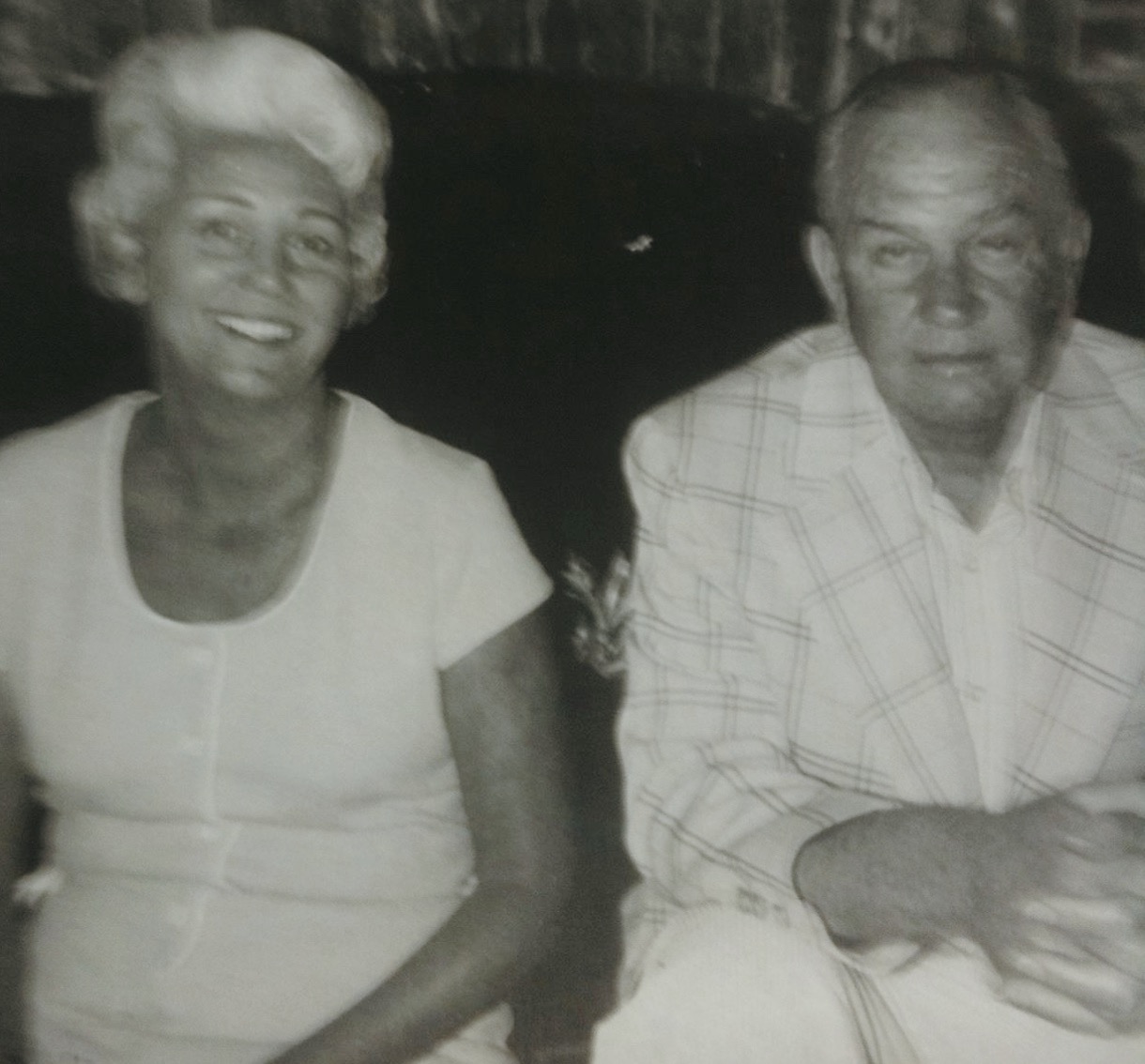
Photo: Johnny and Eunice Burroughs, 1963, as captioned on the official Peaches Corner website.
The restaurant’s official site says Johnny and Eunice ran Peaches for many years and converted an upper portion of the building into living quarters during the busiest seasons. That is a first-party family account, not a present-day service claim, but it gives the right scale of the place: this was not merely a storefront operated from a distance. It was a business whose owners lived with the seasonal rhythm of Ocean Boulevard.Peaches Corner official history
The corner is part of the story
It is easy to talk about Peaches Corner as if the building were separate from its surroundings. It is not. The location is part of the reason the restaurant still feels so specific. The official site lists the address as 900 North Ocean Boulevard, and the restaurant sits at Ninth Avenue North in the heart of the downtown oceanfront corridor.Peaches Corner location
In a 2012 Discover South Carolina feature, the counter was described as a place to watch the Ocean Boulevard flow, with the former Pavilion-era memories, the boardwalk, and the SkyWheel all forming part of the immediate downtown context. The feature is not a current-events guide, so this article does not use it for current operations or programming. It is valuable because it captures the physical logic of the restaurant: people stop at Peaches partly for food, and partly because the corner puts them inside the visual and social traffic of central Myrtle Beach.Discover South Carolina
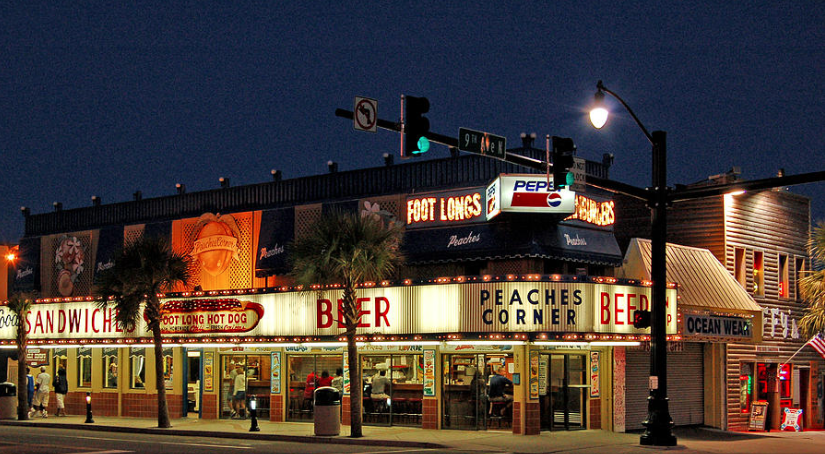
Photo: Official Peaches Corner website; exterior history-gallery image.
That location also explains why small physical details matter. The counter-facing design, the storefront windows, and the sign on the corner are not decorative extras. They are the part of the restaurant that meets the street. The Post and Courier’s 2018 feature described the dining room as compact and the outdoor edge as a way of catching the movement of the boulevard. It also documented the long-running family connection behind the business. Those are more useful observations than any invented claim about a “secret” local menu item or a made-up ranking.The Post and Courier
What the food represents
The official site introduces Peaches Corner through footlong hot dogs and burgers. That simple, focused identity has been part of its public character for decades. The point of a history feature is not to tell visitors what they must order, and it is not a menu audit—prices, specials, and daily availability change. The more durable fact is that the restaurant has kept a recognizable fast-casual, counter-service identity while the downtown around it has changed.Peaches Corner official site
In old business stories, food can become a shortcut for nostalgia. Here, the better reading is continuity. A footlong in this context is not important because it is unusual cuisine. It is important because Peaches has made a familiar kind of beach meal part of a long-running family routine: an Ocean Boulevard stop that can connect grandparents, parents, and children without pretending every generation experienced the street in exactly the same way.
The restaurant’s own historical account includes stories about long summer seasons, old prices, and employees from earlier eras. Those stories are included on the official site because they are part of the family archive. They are not repeated here as present-day facts. That boundary is important: the history is the feature; current details belong with the restaurant directly.
A building that can change without losing its point
Peaches Corner has not avoided change. Discover South Carolina documented a major 75th-anniversary refresh that included updated counters, coolers, tile, exterior signage, and a redesigned corner sign with “Since 1937.” The same story described the intent as preserving an old-school look while the surrounding downtown continued to evolve.Discover South Carolina
That is the clearest explanation of what makes Peaches Corner special. It is not special because nothing has changed. It is special because changes have been made in a way that keeps the history legible. The business can upgrade a counter, adjust a sign, or operate on a street with a different skyline than it had decades ago, while still leaving visitors with a visual clue that this is a place with a long memory.
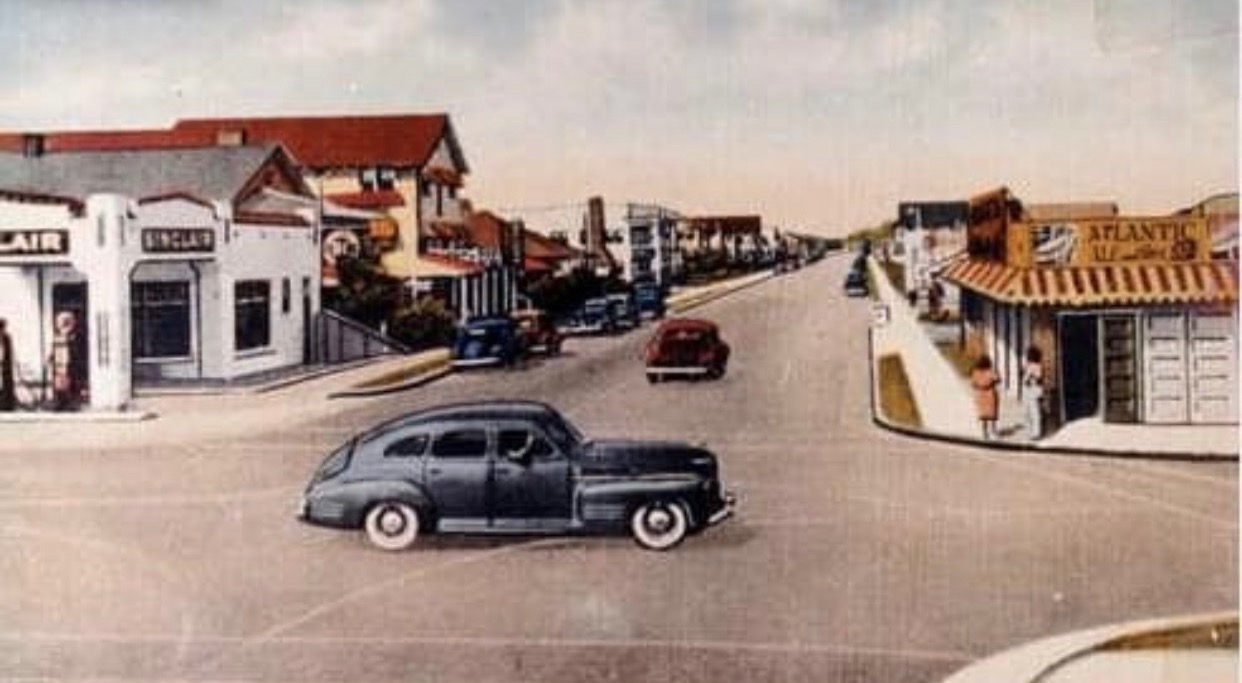
Photo: Official Peaches Corner website; vintage Ocean Boulevard history-gallery image. The site does not provide a specific year, so none is assigned here.
The official photo gallery is especially useful in that regard. Its historic streetscape images do not need to be forced into an exact date to do their work. They show an older Ocean Boulevard context and invite the correct comparison: the street has changed, but this corner has remained a reference point in the restaurant’s own record.Peaches Corner official history gallery
How to experience it without turning it into a cliché
If Peaches Corner is on your Myrtle Beach list, give the block more than a drive-by. Walk the immediate Ocean Boulevard area and use the restaurant as a landmark rather than treating it as an isolated stop. Pair the history with the Myrtle Beach Central guide, then use the parking guide to plan the practical part of downtown. For a broader look at the corridor, read Myrtle Beach: 1990 Ocean Boulevard after it is published.
The honest takeaway is simple. Peaches Corner is a restaurant with a documented 1937 origin, a family story that turned in 1943 with the Burroughs purchase, and a location that has kept it close to the everyday theater of Ocean Boulevard. Its significance comes from that combination—not from a claim that it is the “best” at anything, and not from a version of the past that ignores change.
It is a small corner with a long memory. That is more than enough.
Sources
- Peaches Corner — official story, location, and history gallery
- Discover South Carolina: Peaches Corner gets new look, keeps great view
- The Post and Courier: Peaches Corner is older than the city of Myrtle Beach and still top dog of attractionsof they didn't want their favorite spot getting ruined. Can't say I blame them.
Here's what the talkative ones kept naming. No rankings, no scores — just the places locals couldn't help but mention.
The name that kept coming up: Socastee Station
If there was a consensus pick, this was it. Socastee Station came up more than any other spot in the whole thread — it was simply the default answer, the place that came to mind first. Nobody named a specific dish; they didn't have to. When that many different people land on the same place unprompted, that's the headline. If you only try one place off this list, make it this one.
Local favorites
These are the names that kept surfacing again and again:
Victoria's Country Kitchen — Down on 3rd Ave S in Myrtle Beach, serving country cooking that one commenter called "the absolute best." This is meat-and-three territory, done right.
Judy Boone's — Over in Murrells Inlet. "Excellent — we are there often," said one local, which is about as strong an endorsement as it gets. Regulars don't lie"="article-image-credit">Photo: exploregrandstrandsc.com
Bistro 90 — An upscale pick that locals clearly don't think of as a tourist spot, which is exactly why it belongs here.
Bimini's Oyster Bar & Seafood Market — Oysters and seafood with a market attached. When locals want seafood without the strip-mall markup, this is where they go.