The Bowery: The Little Bar That Made Alabama
The Bowery has stood on 9th Avenue since 1944 — and for seven summers, three cousins from Fort Payne made it the room where Alabama learned to work a crowd.
Category: guide | Published: 2026-11-17
Eighty-two years on 9th Avenue, seven summers of tip-jar sets, and the room where the biggest country band in the world learned how to work a crowd
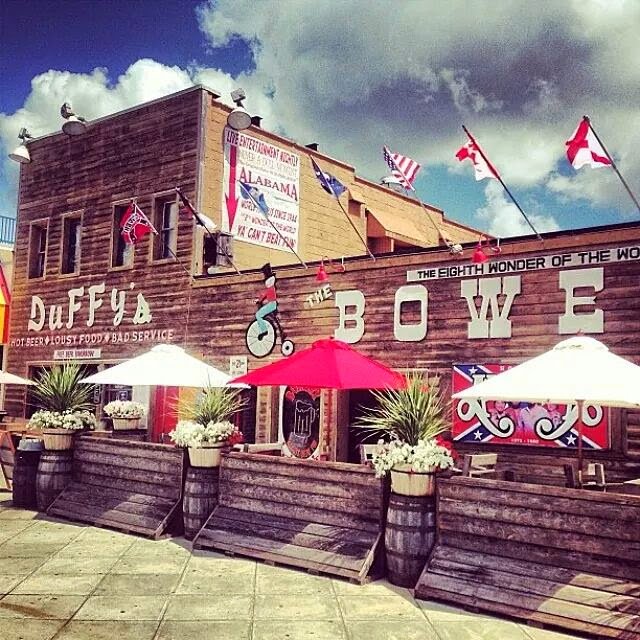
Walk into The Bowery on a night in season and nothing about the place is trying to impress you. The ceiling is low and black. The floor is concrete. Some of the chairs have been under drinkers for fifty or sixty years. At 8:30 the house band steps up, the tip jar goes out, and the requests start coming.
That's not a throwback act. That's just how this room has always worked — including the seven summers when the house band was three cousins from Fort Payne, Alabama, who hadn't been famous yet.
Plenty of bars can say a star once played there. The Bowery can say something nobody else in country music can: the biggest country band of all time was its house band, playing six nights a week for tips and beer, learning the trade one request at a time. Then they walked out in the middle of the summer of 1980 with a record deal — and the bar just kept going. It's still going. That's the story.
A bar built for a beach at war
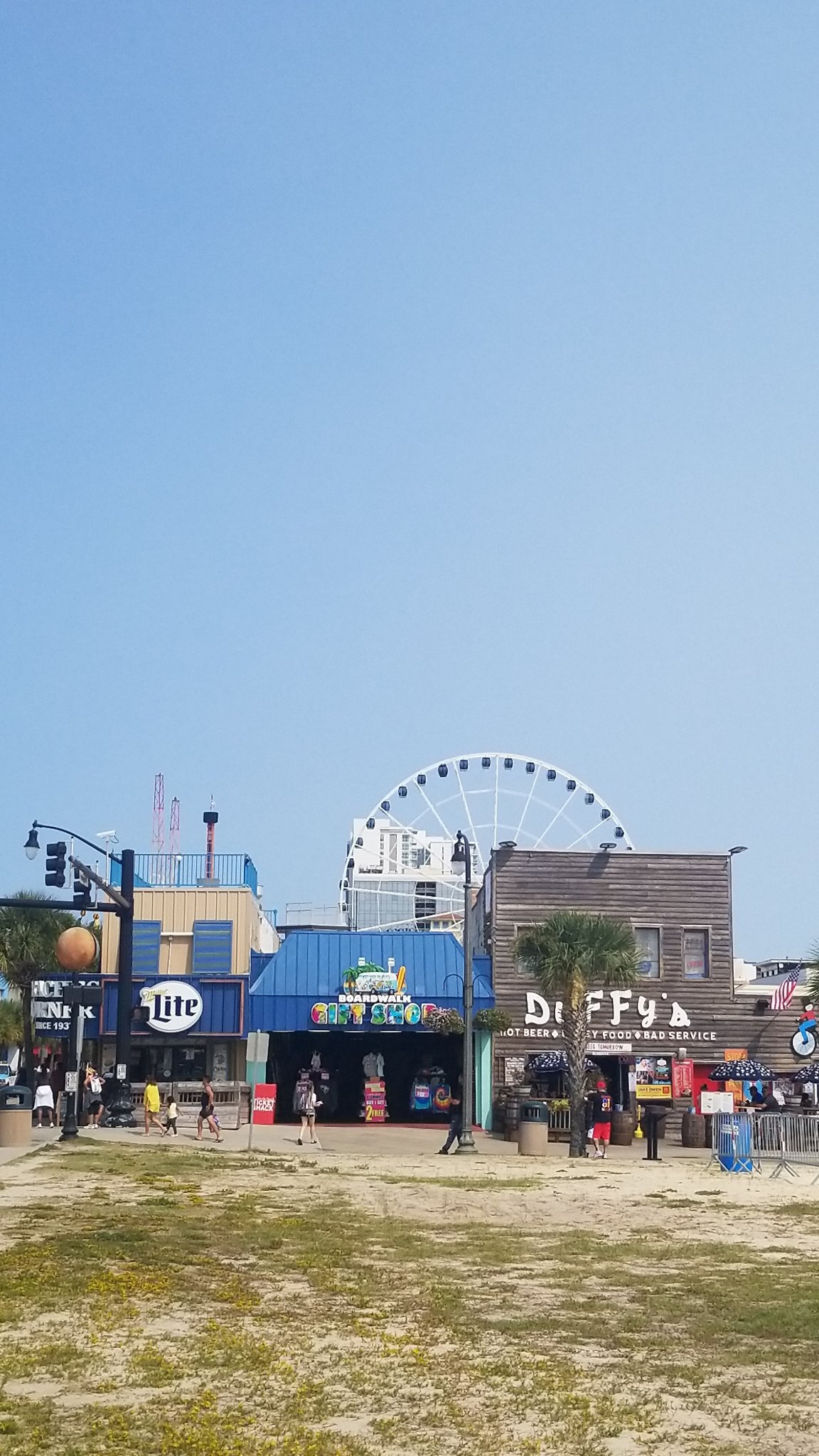
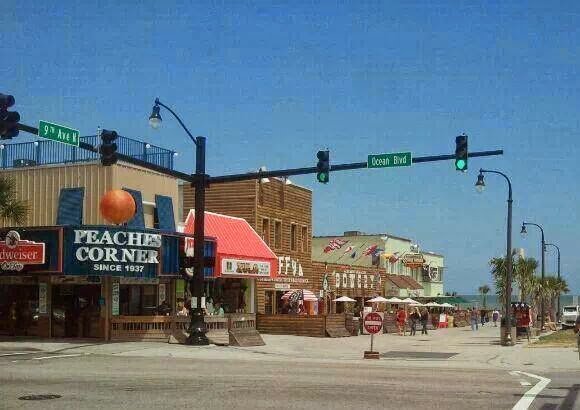
The historical marker out front credits Jack Cook and Cooter Jennings with building The Bowery in 1944, on 9th Avenue North, fifty yards from the Atlantic by the bar's own measure. Myrtle Beach was a different place then — a wartime beach town serving visitors, locals, and the men stationed at the U.S. Army Air Corps airfield out where Market Common stands today.
The Bowery faced the side of the Myrtle Beach Pavilion. It didn't face it long in that form: on December 28, 1944 — the Bowery's first year — the old wooden Pavilion burned to the ground. A fireproof concrete Pavilion rose in its place by 1949 and became the beach's landmark for two generations.
This is the part to sit with: the Pavilion is gone. Its last public day was in September 2006, and demolition ran from that December into 2007. The lot across Ocean Boulevard sits empty. The little bar that faced its side door is still pouring.
The room before the band
Long before Alabama, the Bowery was a novelty-act room, and the staff was part of the show.
The singing bartender was "Don't Cry Joe" Shotkus, who poured beer from the day the place opened in 1944 until he died in 1997 — fifty-three years behind one bar. Before the Bowery existed, Joe and his sister Mary had set a marathon-dancing record of 5,295 hours back in the 1930s. The bar was in his blood before it had walls.
Shirley McPherson sang there from 1963 to 1966 — the marker calls her the first woman to sing professionally at the Bowery. In the 1970s, a dancer named April performed on the ceiling. Bouncin' Betty, billed as a 300-pound go-go girl, kept the beat into the '80s. In the summer of 1979, a three-time Guinness-record sword swallower named Count Desmond worked the room.
Hold onto April. She comes back in this story wearing a second hat.
March 1973: three cousins take the stage
The band formed in Fort Payne, Alabama, in 1969 — cousins Randy Owen, Teddy Gentry, and Jeff Cook. By Owen's own account, they came to Myrtle Beach the week of March 12–14, 1973, to start a summertime house-band job at the Bowery. Owen played that first week on his spring break from Jacksonville State, then went back and finished school — the university let him graduate in absentia — and came back for good.
They played the Bowery as Young Country, and later under the name Wild Country, before the name Alabama stuck. They stayed seven summers.
The tip-jar years
Understand what the job was. Six nights a week. Tips and beer. The crowd called the songs, and the crowd did not grade on a curve.
By the account of the 2026 Jacksonville State documentary on Owen's life, the sets ran six hours a night without a break, and the band learned every style there was because the requests demanded it — Skynyrd and Haggard were the covers that paid best. New original songs got tried out on that crowd, too. Owner Victor Shamah tells it plain: "They could try out all of their new songs on the bar audience and find out what the public wanted." The Bowery crowd, he says, was an unwitting focus group for the hits that followed — and "they came to The Bowery as musicians, but they left as entertainers."
The documentary credits this room with early versions of "My Home's in Alabama," "Tennessee River," and "Mountain Music" taking shape in front of those drinkers. And there's one Bowery song story with a name on it: Owen wrote "Feels So Right" at seventeen and played it here. When he thought about rewriting the second verse, a girl from West Virginia in the crowd told him to leave it alone. He did.
The tip jar had a whole economy around it. Kathy Stack, a Bowery dancer, managed the band's tips and their album and T-shirt sales. Waiter Price "Scuba" Osborne held a Guinness record for carrying 34 mugs of beer a hundred feet without a tray and without spilling a drop — and when the band left in 1980, Scuba went with them, along with doorman Bruce Barnett and waiter Frank Sands, who drove their bus. The bar didn't just train the band. It staffed the road crew.
The managers those years were Larry and Toni McDaniel, who ran Duffy's and the Bowery through the whole residency. Toni was also April — the ceiling dancer was the co-manager. That was the Bowery: everybody worked two jobs, and one of Toni's was upside down.
Somewhere in those summers, Owen met a girl at the bar named Kelly. They wrote letters. In February 1975, they got married in Trenton, Georgia.
The drum chair tells the grind in miniature: Bennett Vartanian played the first season and left. Rick Scott held it by 1977. In 1979, Mark Herndon sat down behind the kit — and the classic lineup was complete.
July 1980: signed in April, gone by summer
On April 21, 1980, Alabama signed with RCA Records. They didn't leave that day. They played into the season — and then, in July, at the height of the summer, they were gone. The documentary puts the last Bowery night at July 12, 1980.
What happened next is the record book: a streak of 21 consecutive number-one singles, tens of millions of records sold, more than 200 major awards, and induction into the Country Music Hall of Fame on November 15, 2005. In 1997 they cut "Dancin', Shaggin' on the Boulevard," name-checking the Bama boys at the Bowery outright — the house band putting its old room into a song, seventeen years after leaving it.
They kept coming back, too. Jeff Cook returned for the Bowery's major anniversary events for the rest of his life — he died November 7, 2022, after a long fight with Parkinson's. In April 2013, Alabama played a free concert at the Bowery to kick off their "Back to the Bowery" tour. And when the bar turned 75 on February 23, 2019, members of the band showed up and played their old room again.
The kid next door buys the bar
When Alabama signed with RCA, the woman who owned the bar — JoJo Layer, who with her husband Dick had run the Bowery and Duffy's Tavern next door through the Alabama years — wanted to sell. The band thought about buying it themselves. They hadn't made their millions yet, and they couldn't.
Victor Shamah could — barely. His family owned the little beachwear shop next door, and teenage Victor had sold Wild Country T-shirts there and traveled with the band in the off-seasons slinging merch. He was 22. He sold his car, borrowed money from his dad for the down payment, and took an owner-financed deal from JoJo Layer. In his own words: "I figured it was easier to be an owner than a roadie."
He became only the third owner in the bar's history, in the early 1980s, and he put his stamp on it fast — "The 8th Wonder of the World" and "Ya' Can't Beat Fun" are Shamah's own registered slogans, not 1944 originals. He replaced a wall with a half-wall and chicken wire. He mostly left the rest alone: the stage and its mural, the concrete floor, the black ceiling, chairs older than most of the customers. Over in Duffy's, the bar itself was built by bartender Ed Hall — and it's still in use.
Shamah is still there, a daily fixture, now with his son Michael and his brother Stuart in the operation. When Hurricane Florence came ashore on September 14, 2018, Shamah rode it out at the Bowery — the way, photographers on the scene noted, he has ridden out most hurricanes: at his bar.
His summary of who built the place deserves the last word in this section: "We built the Bowery on blue-collar folks from North Carolina, South Carolina, the weekend warriors who'd come from their jobs and spend the weekend, and often their paychecks."
Still a working bar
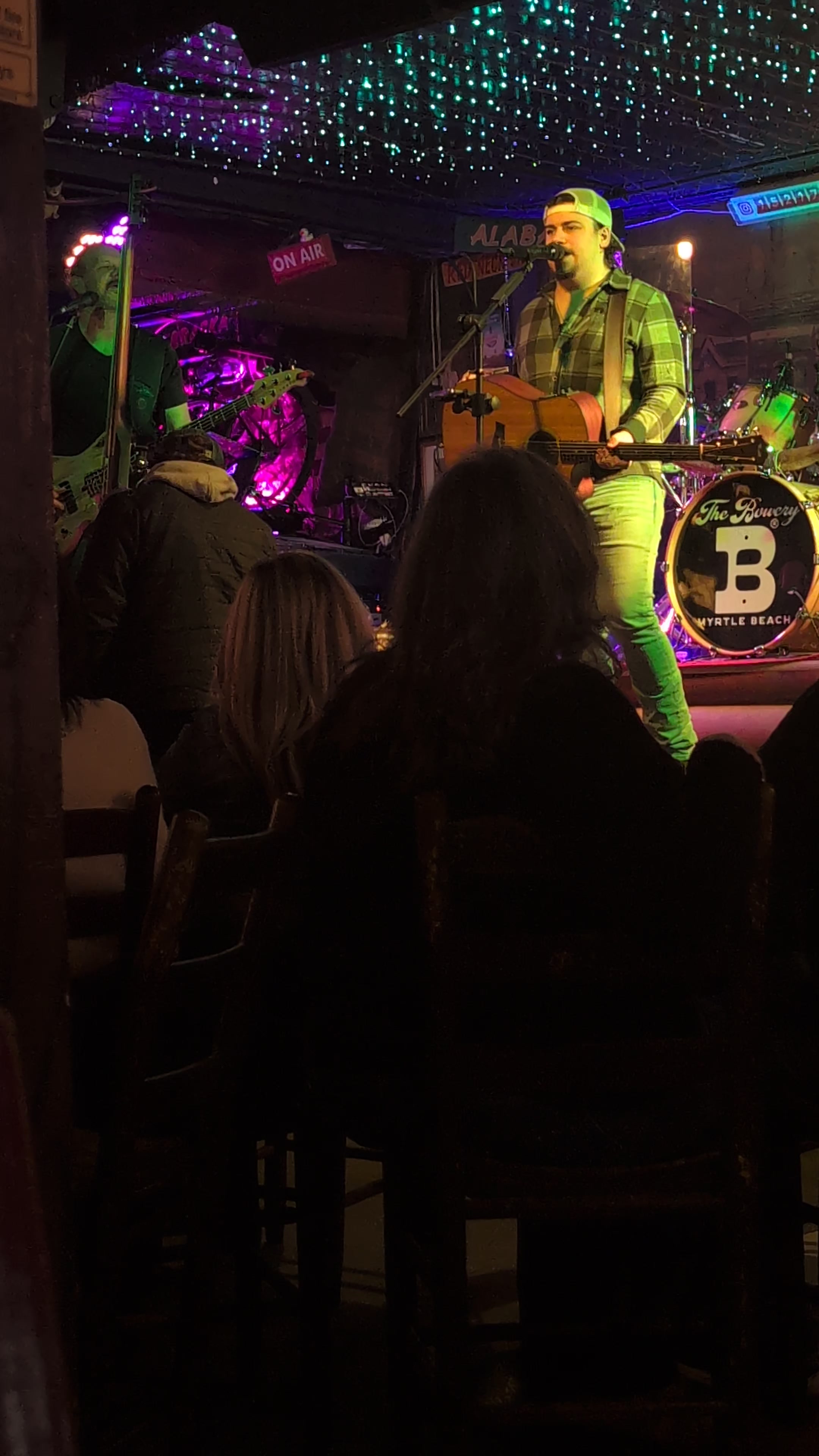
The easiest trap with a place like this is writing about it like a museum. The Bowery refuses to cooperate. On a recent August night, a visitor review put it straight: the Bowery "is not simply living off its past."
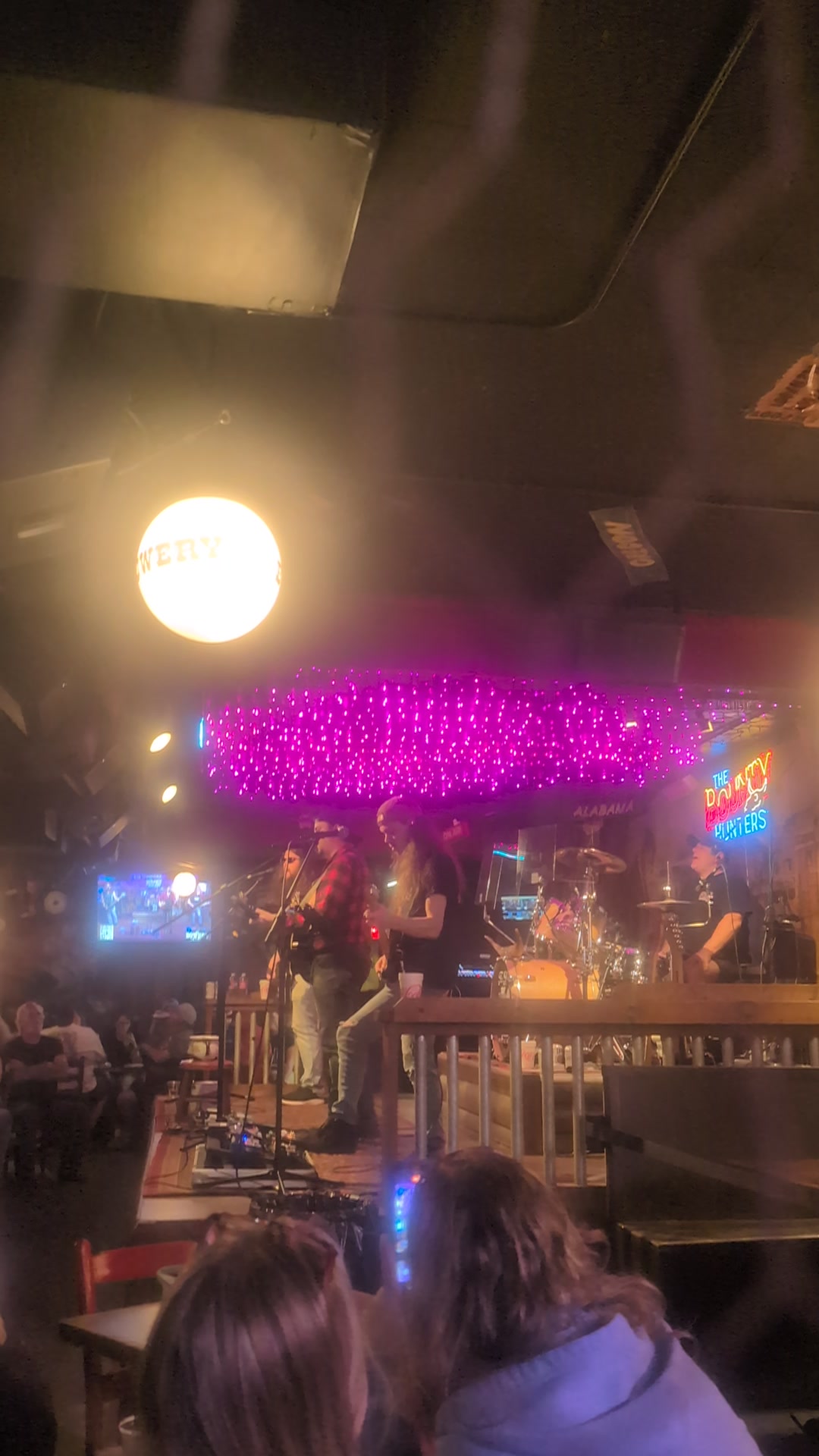
The current house band, the Bounty Hunters, works the same job Alabama worked: a request-driven "human jukebox," in Shamah's phrase — "because they work for tips." Yes, the tip jar is still out. Front man Lee Travis has been working that crowd since the mid-2000s. The band's season runs March through October — they wrapped their 2026 season at the end of October and head back out on the road for the winter, same as the format has worked for years. On October 24 of this year, an Alabama tribute act from Fort Payne — the band's own hometown — played the room. And the room still catches acts on the way up: the Red Clay Strays played the Bowery in November 2019, years before anybody outside a honky-tonk knew their name.
Even the menu is a roster. The dishes are named for the bar's people — Mouse's Kickin' Chicken Fingers, Bear's Not'cho Ordinary Nacho Supreme, and a page more of them. Eighty-two years in, the Bowery still puts its staff on the menu and its history on the walls, and then it opens the doors at 11 in the morning and goes to work.
Why this one matters
Country music's biggest night is built on stars. The Bowery is where the biggest band the genre ever produced learned to be stars — not in a studio, not on television, but in a low-ceilinged room fifty yards from the ocean, one request and one dollar in the tip jar at a time, in front of blue-collar weekend crowds who told them the truth.
The Pavilion across the street was bigger, grander, and more famous. It's a vacant lot. The Bowery outlasted it the only way anything on this beach outlasts anything: it never stopped being useful to the people who walk in the door.
Ya' can't beat fun. They've been proving it since 1944.
Go see it: The Bowery, 110 9th Ave N, Myrtle Beach. Open daily from 11 AM. The Bounty Hunters just wrapped their 2026 season and return in March — when they're on stage, bring cash for the tip jar. It's tradition.
Holding Down the Strand is MBU's series on the Grand Strand places that are still standing and still doing the job.